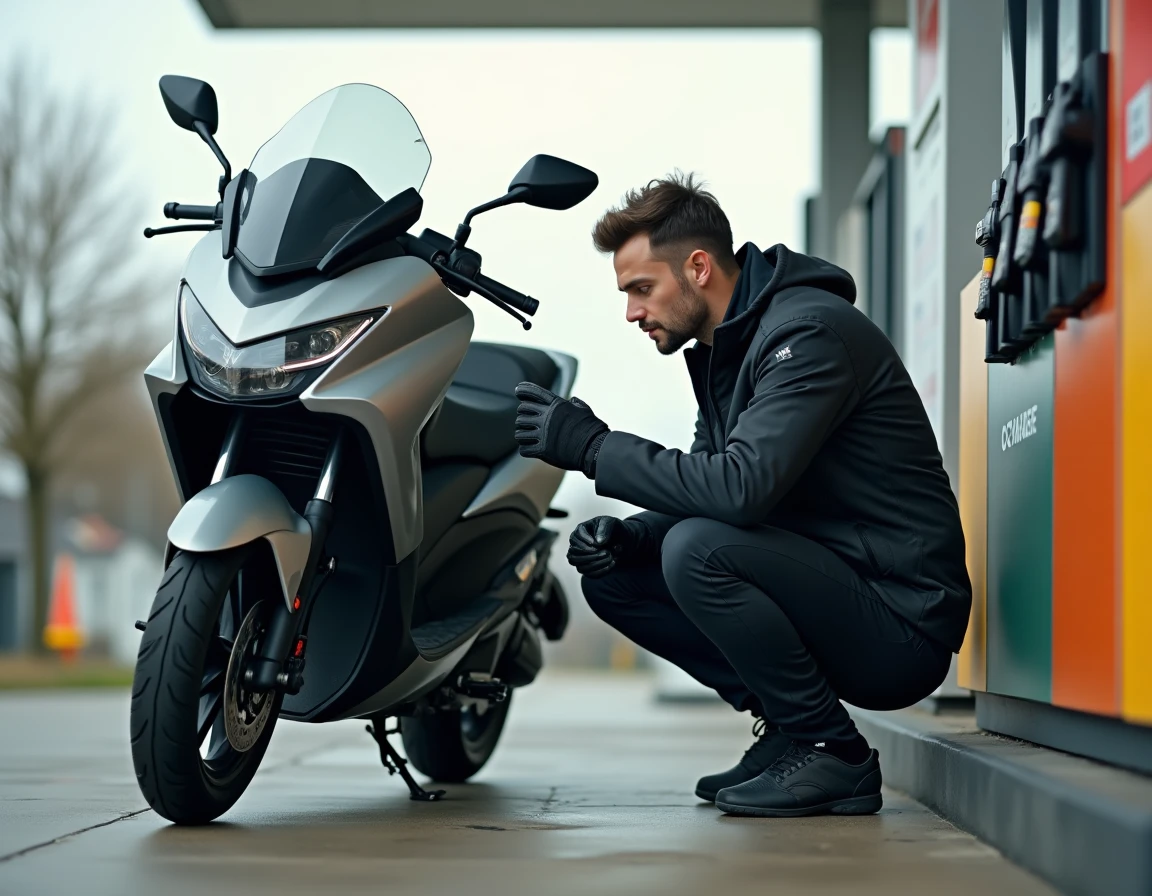
The Yamaha Tmax 530 accepts several types of unleaded fuel available at French gas stations. However, the question of fuel choice for this maxi-scooter frequently arises on forums, where opinions vary between supporters of SP95, SP98, and those who use SP95-E10 without a second thought. The reliable starting point remains the owner’s manual provided by Yamaha, whose recommendations vary according to the model year and the market in which the vehicle is sold.
Tmax 530 and ethanol: what the E10 content actually changes
The online content largely addresses the general compatibility of fuels with motorcycles and scooters. However, it overlooks a technical point that directly concerns the Tmax 530: the difference between mechanical compatibility and fuel behavior under usage conditions.
SP95-E10 contains up to ten percent ethanol. This biofuel is hygroscopic, meaning it absorbs ambient moisture. On a Tmax used daily for urban or suburban trips, this property generally does not pose a problem: the fuel is frequently renewed and does not stagnate in the tank.
The situation changes for intermittent or seasonal use. A Tmax 530 left idle for several weeks with a tank partially filled with SP95-E10 may experience difficulties upon restarting. Ethanol, by capturing moisture, promotes phase separation in the tank. The heavier water-ethanol mixture settles at the bottom and can reach the fuel system.
To identify the suitable fuel according to CarburAuto, one must therefore cross-reference the manufacturer’s recommendation with their own usage profile, which few generic guides offer.
SP95 or SP98 for a Tmax 530: beyond the octane rating
The octane rating measures the fuel’s resistance to knocking. SP98 offers a higher rating than SP95, giving it better resistance to detonation (knocking). On a high-compression or high-revving engine, this advantage translates into smoother operation.
The twin-cylinder engine of the Tmax 530 is not a sport engine pushed to its limits. Its compression ratio, designed for versatile use, does not necessarily require SP98 to operate under normal conditions. Regular SP95 meets the mechanical needs of the Tmax 530 in the vast majority of situations.
SP98 has another advantage, less often mentioned: it contains less ethanol than SP95-E10, generally around five percent maximum. This fuel stores better and is more stable during periods of inactivity. For an owner who alternates between regular trips and extended breaks, SP98 may therefore be justified not by octane, but by the chemical stability of the fuel in the tank.
When SP98 is justified on the Tmax 530
Field reports vary on this point. Some users report slightly smoother operation with SP98, particularly at low revs in the city. Others notice no difference. The available data does not allow for a conclusion on measurable performance gains for this specific model.
However, three situations make SP98 relevant:
- Storing the scooter for more than three weeks, where the lower ethanol content of SP98 limits risks related to moisture absorption
- Extended high-speed riding on the highway, where the continuously stressed engine benefits from better resistance to detonation
- Use in regions with significant temperature variations, where the stability of SP98 reduces cold starting problems
Yamaha Tmax owner’s manual: the only reliable reference
Forums and Facebook groups dedicated to the Tmax are full of contradictory testimonials. One user swears by SP98, while another has been using SP95-E10 exclusively for years without any issues. These individual reports do not replace the recommendation of the owner’s manual, which remains the reference document for determining the appropriate fuel for each version of the Tmax 530.
This point deserves emphasis: manufacturer recommendations may vary by model year. A 2012 Tmax 530 and a 2017 model do not necessarily share the same specifications due to mechanical evolutions or updates to injection systems. Checking the manual corresponding to one’s year of manufacture avoids relying on generic advice that may not apply to one’s own machine.
What the manual doesn’t always say
The Yamaha manual indicates the recommended fuel type and minimum octane rating. It does not detail the consequences of prolonged use with a fuel rich in ethanol, nor the precautions related to storage. The manual covers technical compatibility, not optimization according to usage profile.
This is precisely where the gray area lies. A compatible fuel is not necessarily the most suitable. SP95-E10, technically accepted by most Tmax 530s, may not be the best choice for a scooter that only runs every other weekend.
Fuel for Tmax 530 and maintenance of the fuel system
The choice of fuel has direct repercussions on certain components of the fuel system. Ethanol, even in small proportions, is a solvent. On old hoses or seals, it can accelerate the degradation of rubber materials not designed to withstand this type of compound.
On a recent Tmax 530, the materials in the fuel system are generally designed to tolerate E10. On an older model or a used scooter with an incomplete maintenance history, checking the condition of the hoses and seals in the fuel system before permanently switching to SP95-E10 is a matter of mechanical common sense.
Periodic cleaning of the injection system and checking the fuel filter complement this approach. These operations do not depend on the type of fuel chosen, but their frequency may increase if the scooter regularly runs on a fuel with a high ethanol content.
The choice between SP95, SP98, and SP95-E10 for a Tmax 530 is not just a question of price per liter or personal preference. It is a trade-off between the manufacturer’s recommendation, the frequency of scooter use, and the condition of its fuel system. Three parameters that every owner can assess without special equipment, manual in hand.