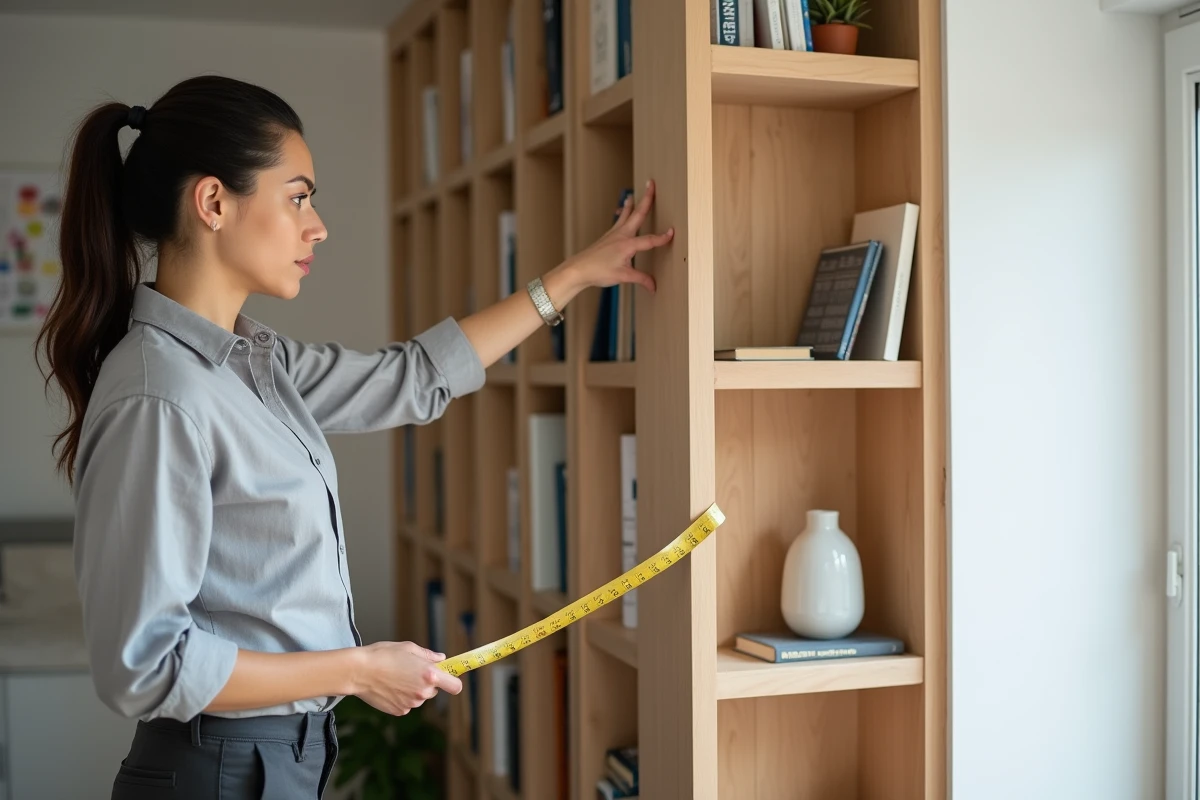
A poorly sized bookshelf cannot be compensated for with decoration. If it’s too deep, it wastes usable volume and projects the furniture into the room. If it’s too tall without anchoring, it poses a safety issue regulated by European standards. The dimensions of a bookshelf are calculated based on precise technical constraints, not just a glance at the available wall space.
Bookshelf Depth: The Parameter Catalogs Oversimplify
The standard depth displayed by most manufacturers is around 25 to 30 cm. This measurement is suitable for novels and paperback books, but it becomes insufficient as soon as mixed uses are integrated.
Since 2022, best practice guides in interior design have noted a trend to incorporate specific niches for speakers, turntables, and internet boxes into bookshelves, with depths of 35 to 45 cm and ventilated cable passages to prevent overheating. Planning a uniform depth across the entire height of the furniture ignores this practical reality.
We recommend working with at least two distinct depths: a lower or middle zone at 35-45 cm for multimedia and art books, and upper shelves at 25 cm for standard formats. On a custom-made piece, this variation in depth costs almost nothing extra in manufacturing but radically changes functionality. To delve deeper into bookshelf dimensions according to Maisonea, the layout standards are detailed with measurements by object type.
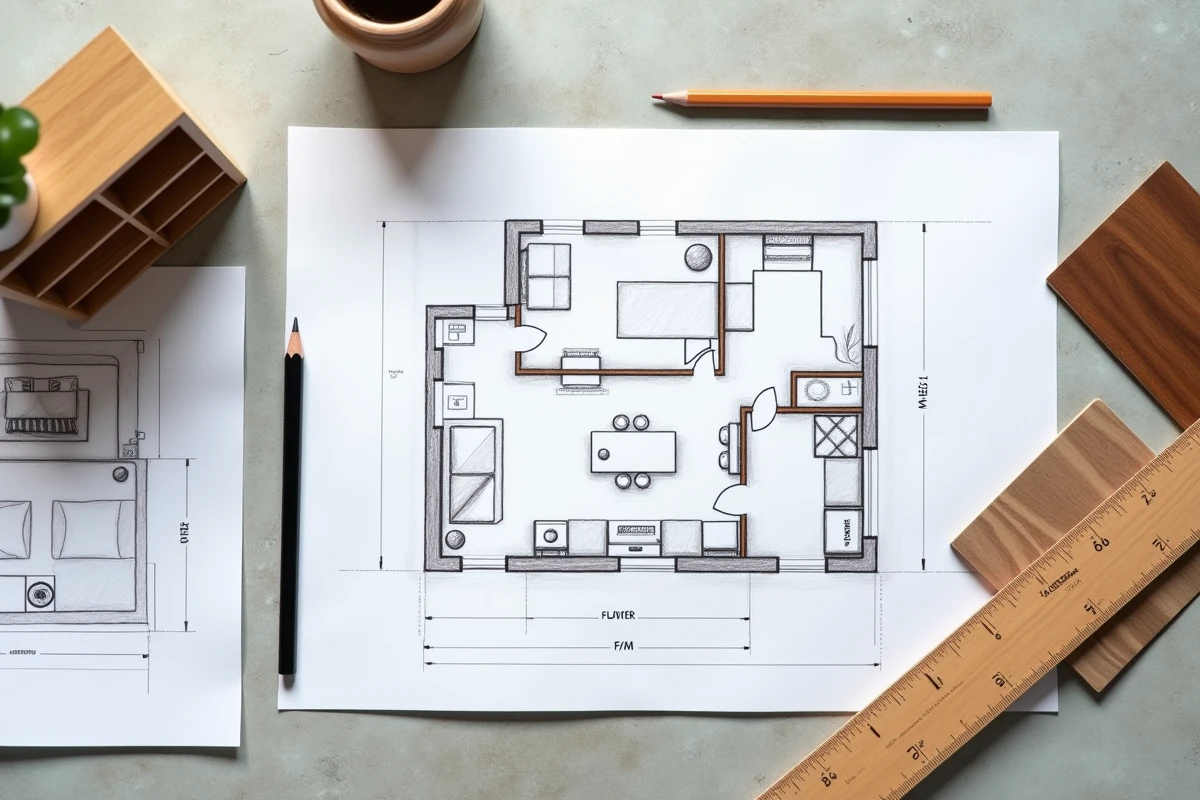
Shelf Height and Ergonomic Comfort Zones
Ergonomics is not a luxury reserved for professional offices. Recommendations from the INRS (file “Workstation Layout,” updated 2023) identify a grasping comfort zone between 70 and 160 cm from the floor. This range should contain frequently handled items.
Above 160 cm, each item retrieval stresses the shoulder in elevation. Below 70 cm, the back compensates by bending. For a home bookshelf loaded with heavy books (art books, comics, A4 binders), placing these formats in the high zone means programming repeated, constrained movements.
Recommended Vertical Distribution
- Lower zone (0 to 70 cm): infrequently accessed storage, heavy items but rarely moved, or closed drawers that do not require visual reading of the spines
- Middle zone (70 to 160 cm): common books, novels, work documents, everything that can be grabbed daily without effort
- Upper zone (above 160 cm): decorative objects, display books consulted a few times a year, or storage in opaque baskets
This distribution logic should guide the choice of the total height of the furniture. A 220 cm bookshelf with five regular shelves ignores these ergonomic levels. It is better to space the shelves differently according to the zone.
Stability and NF EN 14749 Standard: Wall Anchoring for Tall Furniture
The NF EN 14749:2016+A1:2022 standard governs the stability of domestic storage elements. It imposes requirements for anti-tipping devices for tall and narrow furniture. The risk of tipping increases with the height/depth ratio and the load concentrated on the upper shelves.
Specifically, a bookshelf whose height exceeds four to five times its depth must be anchored to the wall. A piece that is 200 cm tall and 25 cm deep falls into this category. The standard explicitly addresses scenarios involving pulling by a child or light seismic activity.
What This Means for Sizing
If your wall does not allow for drilling (plasterboard partition without accessible studs, stone wall without suitable anchors), you need to reconsider the proportions of the furniture. Increasing the depth to 35-40 cm or limiting the height to 150 cm reduces the risk without anchoring. We observe that many bookshelves sold in large stores exceed this critical ratio without providing a wall mounting kit, which poses a real compliance issue.

Shelf Width and Bending Under Load
The width of a shelf between two vertical supports determines its resistance to bending. Beyond 80 cm without intermediate support, a particle board shelf bends under a load of books. The phenomenon is gradual and irreversible: deformation increases over time, even without adding weight.
Solid wood or plywood can tolerate longer spans, but the cost increases proportionally. In melamine board (the most common material in the market), we recommend not exceeding 60 to 70 cm of free span for shelves loaded with books. Beyond that, an intermediate support or a back reinforcement becomes necessary.
- Melamine particle board: maximum span of 60 to 70 cm under a load of books
- Plywood (18 mm and above): possible span up to 90 cm depending on the wood type
- Solid wood (oak, beech, 22 mm and above): comfortable span up to 100 cm, but with a corresponding weight of the furniture
This bending criterion should be included in any specifications before validating the total width of the furniture. Dividing a 180 cm piece into two spans of 90 cm rather than three of 60 cm may seem trivial, but the difference in durability over time is considerable with melamine.
Adapting Bookshelf Dimensions to the Intended Room
A living room with a sofa facing another requires a visual setback that an office or bedroom does not. In a living room, a full-height bookshelf on an entire wall works because the setback allows for a complete view. In an eight-square-meter office, the same piece overwhelms the room.
For a bedroom, reduced depth (20-25 cm) is suitable if storage is limited to bedside books and a few items. The bedroom bookshelf benefits from staying under 150 cm tall to avoid visually dominating the bed. In a wide hallway, a shallow bookshelf (20 cm) utilizes otherwise wasted space, provided the furniture is anchored to the wall in accordance with the NF EN 14749 standard.
The sizing of a bookshelf relies on a trade-off between shelf spans, variable depth according to uses, and height calibrated to ergonomic comfort zones. Each compromise on one of these parameters comes at the cost of functionality or durability of the furniture.