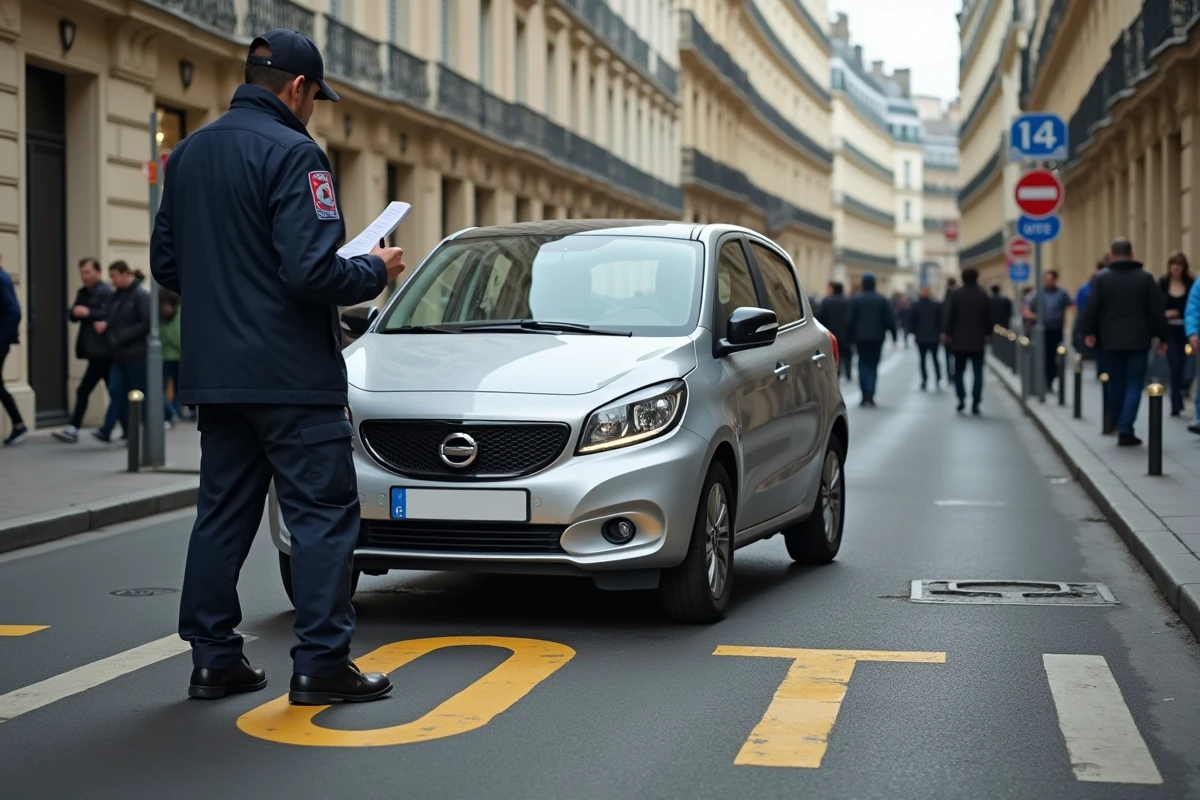
Solid yellow line along a sidewalk, broken line on the roadway, zigzag in front of a school: the yellow ground markings cover very different types of prohibitions. Each type of line incurs distinct penalties, from a simple fixed fine to towing. Understanding precisely what each marking prohibits helps avoid fines whose amounts vary according to the class of offense committed.
Penalties According to the Type of Yellow Ground Marking: Comparative Table
Violations related to parking on yellow markings do not all fall under the same class of offense. The table below summarizes the main situations encountered in urban areas.
| Type of Yellow Marking | Prohibition | Class of Offense | Towing Possible |
|---|---|---|---|
| Solid yellow line (along the sidewalk) | Stopping and parking | 4th class | Yes |
| Broken yellow line (along the sidewalk) | Parking (stopping allowed) | 2nd class | No (except in special cases) |
| Yellow zigzag (in front of schools, hospitals) | Stopping and parking | 4th class | Yes |
| Delivery space (crossed yellow lines) | Parking outside of delivery | 4th class | Yes |
| Temporary yellow marking (construction site) | Variable according to associated signage | 4th class if crossing is prohibited | According to decree |
The rules regarding parking on yellow lines and bands are based on specific articles of the Highway Code, notably article R417-10 for obstructive parking and article R417-11 for abusive parking.
The distinction between solid and broken lines is the point that generates the most fines due to ignorance. A solid yellow line prohibits both stopping and parking, while a broken line allows for brief stops (boarding or disembarking passengers, quick loading).
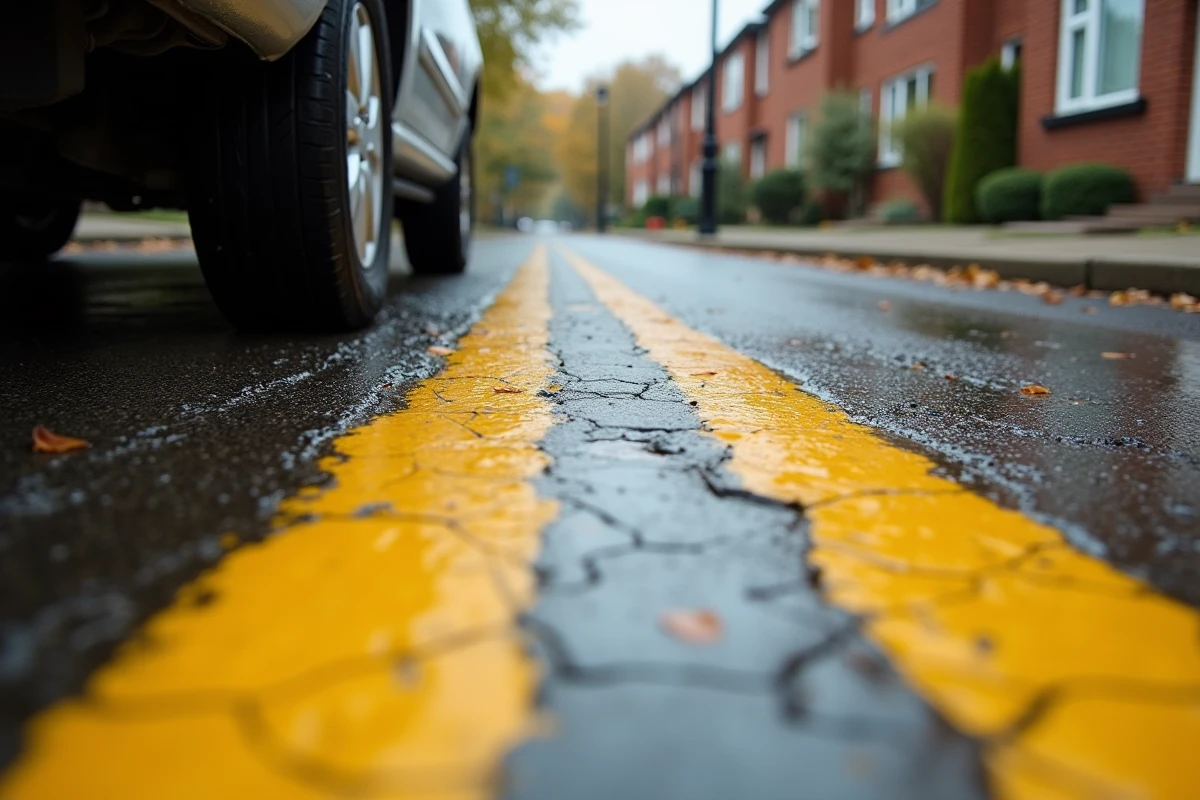
Solid Line and Broken Line: What the Highway Code Actually Distinguishes
The yellow line painted along the edge of the roadway or on the sidewalk curb determines the level of prohibition. Confusion between the two types of lines is common, even among experienced drivers.
Solid Yellow Line Along the Sidewalk
This indicates a total prohibition. The driver cannot park or even stop momentarily. This prohibition applies on the side of the roadway where the line is painted. A vehicle stopped with the engine running is in violation.
The offense is classified as 4th class. It may result in towing if the vehicle obstructs traffic or emergency access.
Broken Yellow Line
This prohibits prolonged parking but allows for stopping. The driver must remain in close proximity to the vehicle or inside it. In practice, dropping off a passenger or picking up a package remains permitted.
Exceeding a few minutes of immobilization turns the stop into parking, and the offense then becomes a 2nd class. The boundary between stopping and parking depends on the duration and the presence of the driver in or near the vehicle.
Delivery Zones and Yellow Zigzags: Towing and Reduced Deadlines by Municipal Decree
Delivery spaces marked by crossed yellow lines are reserved for loading and unloading operations. Parking a private vehicle in a delivery space constitutes obstructive parking of 4th class.
Yellow zigzags, found in front of schools, hospitals, and certain public buildings, follow the same logic: both stopping and parking are strictly prohibited. Towing is systematically possible, as these areas meet safety requirements (visibility, emergency access).
Reduced Towing Deadlines by Decree
Article R417-12 of the Highway Code allows for penalizing and towing a vehicle that has remained in the same place for more than seven consecutive days. Several municipalities reduce this deadline by municipal decree in streets with yellow lines or stripes, particularly in delivery zones, tourist areas, and around markets.
- Some municipalities reduce the deadline to 24 hours in permanent delivery zones marked in yellow
- The decrees also apply to carpooling areas marked in yellow, where vehicle rotation is prioritized
- The ability to shorten the legal duration by municipal decree remains little known to motorists, which explains the high number of tows in these areas
This trend towards increased controls is accompanied by the gradual replacement of old traditional parking spaces with yellow-marked spaces with permanent reservation signs. Areas once tolerated are becoming areas of almost systematic prohibition.

Temporary Yellow Marking and Priority Over Permanent White Marking
During construction or work, temporary yellow marking is placed on the roadway. This marking takes precedence over permanent white marking, even if both coexist visually. The driver must follow the yellow indications and ignore the covered or adjacent white lines.
Temporary yellow marking is always prioritized over white marking. Failing to respect this priority rule exposes one to a 4th class fine, identical to that applied for crossing a solid line.
At the end of the construction, the yellow marking is removed or erased. As long as it remains visible on the roadway, it retains its regulatory value. A white marking partially covered by residual yellow traces may create ambiguity, but the rule remains the same: yellow prevails.
- Temporary traffic signs (yellow background) complement the ground marking and reinforce the prohibition
- A traffic officer present on site can modify the rules indicated by the marking, including temporary ones
- Parking on temporary yellow marking follows the same penalty scales as permanent marking
Yellow ground marking, whether permanent or temporary, follows a uniform logic: to signal a stronger restriction than white marking. The distinction between solid and broken lines remains the determining criterion for assessing the risk of being fined. Checking the type of marking before stopping takes a few seconds and avoids a 4th class fine, or even towing fees that add to the fine.