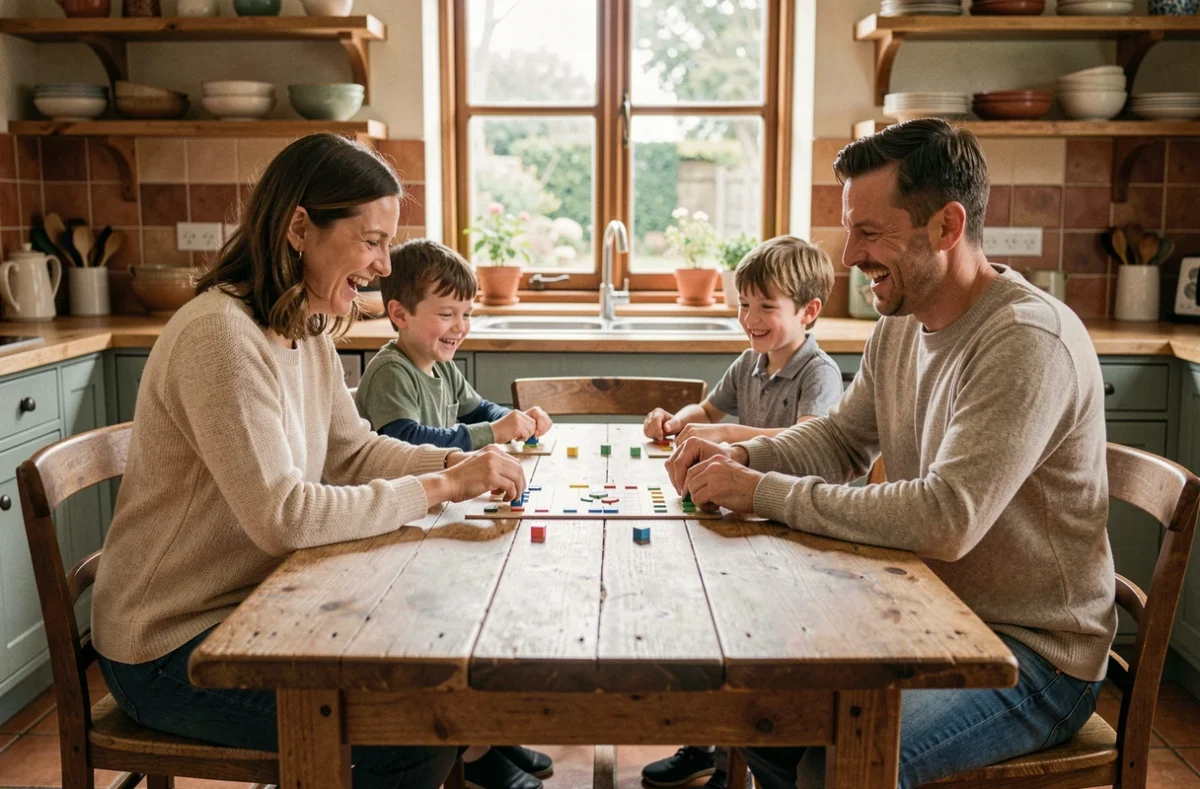
Long dinners, homework that drags on, arguments between siblings: family life swings between moments of closeness and recurring tensions. A more peaceful daily routine doesn’t require perfect organization—just a few practical adjustments that can change the atmosphere at home.
Mental load and sharing responsibilities: the real source of friction
Have you noticed that tension often builds around the same things? Taking out the trash, packing school bags, managing medical appointments. It’s not the tasks themselves that are exhausting—it’s having just one person remember them all.
The mental load eases when everyone knows exactly what they’re responsible for. A chart on the kitchen wall, however basic, makes responsibilities visible. Children as young as six or seven can set the table, put away their shoes, or feed a pet.
The goal isn’t to divide everything equally. It’s to make explicit what often goes unnoticed. Couples who talk through the week ahead every Sunday evening (shopping, school runs, appointments) can avoid many Monday-morning tensions. In Jolie Family’s family section, you’ll find several practical approaches to structuring these conversations without turning home life into a work meeting.

Daily family rituals: creating a sense of routine without being rigid
A ritual isn’t a fixed schedule. It’s a recurring moment that everyone recognizes. A regular routine reassures children and helps parents unwind.
Three easy formats that work
- Sharing a meal without screens, even a short one: fifteen minutes is enough for everyone to talk about something that happened during their day. Consistency matters more than duration.
- Setting aside time for free play on the weekend, with no planned activities. The children choose, and the parents follow their lead. This reverses the usual roles and takes the pressure off organizing everything.
- Having some quiet time at the end of the day (reading, drawing, music) to signal the transition into the evening. This wind-down period helps younger children settle before bedtime.
These rituals don’t have to happen every day to make a difference. Two or three times a week, at predictable times, is enough to create a sense of stability.
Arguments between children: guide them rather than take sides
Arguments between siblings are normal. Stepping in to decide who’s at fault (“he started it”) may calm things down in the moment, but it doesn’t teach them anything.
Naming the emotion before looking for a solution changes the dynamic of a conflict. When a child hears, “You’re angry because he took your toy,” they feel understood. Simply acknowledging their feelings can reduce the intensity of their reaction.
Then, asking the children to come up with a solution themselves helps them take responsibility. “What would be fair to both of you?” often leads to more creative answers than anything an adult might impose. Over time, children start using this approach with each other without parental intervention.
When the conflict is between parents
Disagreements between parents should be handled differently in front of the children and when they’re not around. Showing children how to disagree calmly is educational; exposing them to a heated argument is not. If the subject is sensitive (money, school decisions, household organization), it’s better to continue the discussion after the children have gone to bed.
Financial pressure and family life: a rarely discussed connection
Financial hardship has a direct impact on the atmosphere at home. According to Insee, single-parent families are among the households most at risk of poverty, and that risk increases with the number of children, including in two-parent households.
It would be simplistic to reduce everyday tensions to a lack of communication or organization. When money is tight, every unexpected expense (a breakdown, school costs, a bill) creates stress that affects the whole family.
A few practical steps can help limit this domino effect:
- Identify recurring expenses that can be shared (group shopping trips with neighbors, buying secondhand clothes for children).
- Plan ahead for expensive times of year (back-to-school season, holidays) by spreading purchases over several months.
- Talk about money with children in a way that’s appropriate for their age. A child who understands why the answer is “not right now” handles disappointment better than one who is turned down without an explanation.
According to Insee data, family policies (benefits, housing assistance) have a measurable effect on the standard of living of households with children. Finding out what support you’re entitled to is a practical step that can make a direct difference to everyday life.
Shared family values: a foundation that makes decisions easier
Why do some families seem to weather crises more easily? Often, it’s because they share a few guiding principles, even if they’ve never formally discussed them. Not a set of house rules, just two or three principles everyone knows.
For example: “we don’t make fun of each other,” “we ask before taking something,” “it’s okay to be angry, but not to break things.” Simply stated values can serve as a compass when exhaustion makes it hard to think clearly.
These principles are better taught by example than by lectures. A parent who apologizes for shouting teaches respect more effectively than a long sermon about good manners. Children absorb behavior long before they absorb words.
Family harmony isn’t a permanent state. It’s a direction, with easy days and difficult ones. The families who cope best aren’t those who avoid conflict, but those who know how to find calm again after the storm, because expectations are clear and everyone feels heard.